Spring still produces the fastest sales and strongest offers in Nassau County, but 2026's near-decade-low inventory means well-priced homes sell year-round. If you want a summer closing that aligns with school calendars, list in March or April. If you're already past that window, don't wait until next year.
Should I sell my house this spring in Nassau County?
Spring remains the most active selling season in Nassau County, with more buyers, faster contract timelines, and historically stronger sale-to-list price ratios than any other time of year. But with single-family inventory still near decade-low levels and the median closed sale price hitting $795,000 in June 2026, the market is seller-favorable in every season. Whether spring is worth waiting for depends on your specific timeline, not a calendar rule.
What the data actually says about spring in Nassau County
Spring is real. It's not just a real estate cliché.
According to OneKey MLS data, Nassau County new listings for single-family homes ran about 35–40% higher in May 2025 than in January 2025, and pending sales were roughly 45% higher during the same comparison. More buyers showed up, and more sellers captured them.
The days-on-market numbers tell the same story. Homes listed in spring 2024 (March through May) went under contract in about 22 days on average. Homes listed in Q4 2024 (October through December) took closer to 34 days. That's a 12-day difference that compounds into real negotiating pressure. A buyer who's been waiting since January is a different kind of motivated than a buyer who just entered the market in March.
The Long Island Board of REALTORS® reported that median days to contract in Nassau County in May 2026 was under 30 days, and active listings remained below 2019 pre-pandemic counts. That context matters. You're not selling into a soft spring market. You're selling into a supply-starved one where spring adds demand on top of an already tight base.
Sale-to-list price ratios by season
One number sellers often overlook is the sale-to-list price ratio. It tells you how close to asking price sellers actually receive. In Nassau County, that ratio has consistently been highest for homes listed between March and June, according to OneKey MLS seasonal data from 2023 and 2024. Winter listings still performed well (above 97%), but spring listings performed better.
Here's a summary of how Nassau County seasonal performance has stacked up:
SeasonAvg. Days to ContractSale-to-List RatioBuyer Demand LevelSpring (Mar–May)~22 daysHighest of yearPeakSummer (Jun–Aug)~25–28 daysStrongHigh (early), taperingFall (Sep–Nov)~28–32 daysSolid (above 97%)ModerateWinter (Dec–Feb)~34 daysAbove 97%, slightly lowerLowest, but serious buyers
Source: OneKey MLS Nassau County Seasonal Listing Performance 2023–2024.
Why the school calendar drives spring demand in Nassau
Nassau County is a family-driven market. A large share of buyers here are relocating from Brooklyn, Queens, or Manhattan, and they're timing their move around their kids' school year. The
New York State Education Department calendar has most Nassau public schools ending in late June, which means families want to close between June and August to avoid a mid-year school transition.
Working backward from a July closing, a buyer needs to go under contract by late May. That means they need to find the house by April or May. That's your window.
NAR's 2024 Profile of Home Buyers and Sellers confirmed that school-related timing is a major factor for buyers with children under 18, and in a suburb like Nassau County, that population is a significant share of your buyer pool.
I walk my clients through this calendar math every time. A March or April listing typically produces a May or June contract, which closes in July or August. That lines up perfectly with the school year. A November listing might close in January, which is a harder transition for families.
The commuter buyer factor
Spring also activates a specific Nassau buyer: the NYC-area commuter. Weekend open houses in March through May draw buyers from Brooklyn, Queens, and Manhattan who tour multiple communities in a single day along the LIRR corridors. Port Washington, Merrick, Bellmore, Massapequa, Hicksville, and Mineola all see this traffic. These buyers are often pre-approved and ready to move fast. A Sunday open house in April can produce three competing offers by Monday. In January, that same open house might see four visitors.
Does the current market change the calculus?
Here's where 2026 is different from a textbook seasonal analysis.
The
Freddie Mac Primary Mortgage Market Survey put the average 30-year fixed rate at approximately 6.7% in June 2026. That's down from the 7%-plus peak in late 2023, but it's still well above the sub-4% environment of 2019 through 2021. Elevated rates have done two things simultaneously: they've reduced buyer purchasing power, and they've kept many existing homeowners from listing because they don't want to give up their low-rate mortgages.
The
Federal Reserve Bank of New York documented this "rate-lock effect" in 2024, noting that suppressed move-up and downsizing activity has kept for-sale inventory tight in markets like Nassau County. The result is that even with higher rates dampening some demand, there are still more buyers than homes. Nassau's months' supply of inventory averaged around 2.6 months in Q2 2026, according to OneKey MLS quarterly data. A balanced market sits at 5 to 6 months. You're still well inside seller territory.
A 2023
Realtor.com national report noted that while spring remains the most active season, elevated mortgage rates and low inventory have made demand more evenly spread throughout the year, reducing the penalty for listing outside the traditional spring window. That finding holds in Nassau. Winter sellers face less direct competition from other listings, and serious, rate-sensitive buyers shop year-round.
My read on this: spring still wins on volume and speed. But the gap between spring and other seasons is narrower than it was five years ago, because the inventory shortage creates urgency in every season. A well-priced listing in Farmingdale or Plainview in October doesn't sit. It just might take 30 days instead of 15.
Your specific number, including how your home's condition, location, and price tier interact with seasonal demand, is something I can map out for you in a market analysis. That conversation takes 30 minutes and tells you a lot more than any seasonal average.
How to time your spring listing in Nassau County
If you're reading this in early 2026 and targeting a spring listing, the preparation window is the part most sellers underestimate.
Here's the practical timeline that works in Nassau County:
- January–February: Declutter, address deferred maintenance, get a pre-listing inspection if you want to know what buyers will find. This is also when you should interview agents and discuss pricing strategy. In Nassau County's competitive market, a well-priced listing in the first week beats chasing the market down.
- Late February–early March: Schedule professional photography once the weather allows. Nassau's late-winter landscaping (bare trees, dormant lawns) can hurt curb appeal in photos. Waiting for late March or April greenery is often worth it.
- Early March to late April: Go live. This is the target window to capture peak buyer traffic before Memorial Day. Listings that hit the market in this range have historically shown the fastest absorption and strongest sale-to-list ratios in Nassau.
- May–July: Target closing window if you list in March or April. This aligns with the school calendar and the family-buyer move cycle.
On the closing process itself: Nassau County attorney-handled closings are standard. Both buyer and seller are represented by separate attorneys, who coordinate with the title company, lender, broker, and the Nassau County Clerk for recording. Budget time for a payoff statement on your existing mortgage, resolution of any open permits or certificates of occupancy with your local town or village building department, and final water meter readings or utility settlements. Some incorporated villages, including Garden City and Rockville Centre, have their own CO or inspection requirements that can affect your timeline. An experienced local agent will know which municipalities require what and how to sequence it.
Under New York law, who pays specific closing costs, including transfer taxes and title insurance premiums, is largely a matter of contract negotiation rather than fixed by statute. New York State imposes a real estate transfer tax, and Nassau County imposes its own local transfer fee under county law. Both are real costs, but which party covers which portion is negotiated in the contract. The
New York State Department of Taxation and Finance publishes the statutory transfer tax rates, and the
Nassau County Clerk handles local recording and transfer fee information. Your attorney will walk you through what applies to your specific transaction.
On commissions:
broker fees are fully negotiable and not set by law. There is no standard or customary rate in New York. The listing fee is agreed in your listing agreement, and any compensation offered to a buyer's agent is a separate, optional decision. If you want to understand what those agreements look like and how they affect your net, that's a conversation to have directly with me, not something to estimate from a blog post.
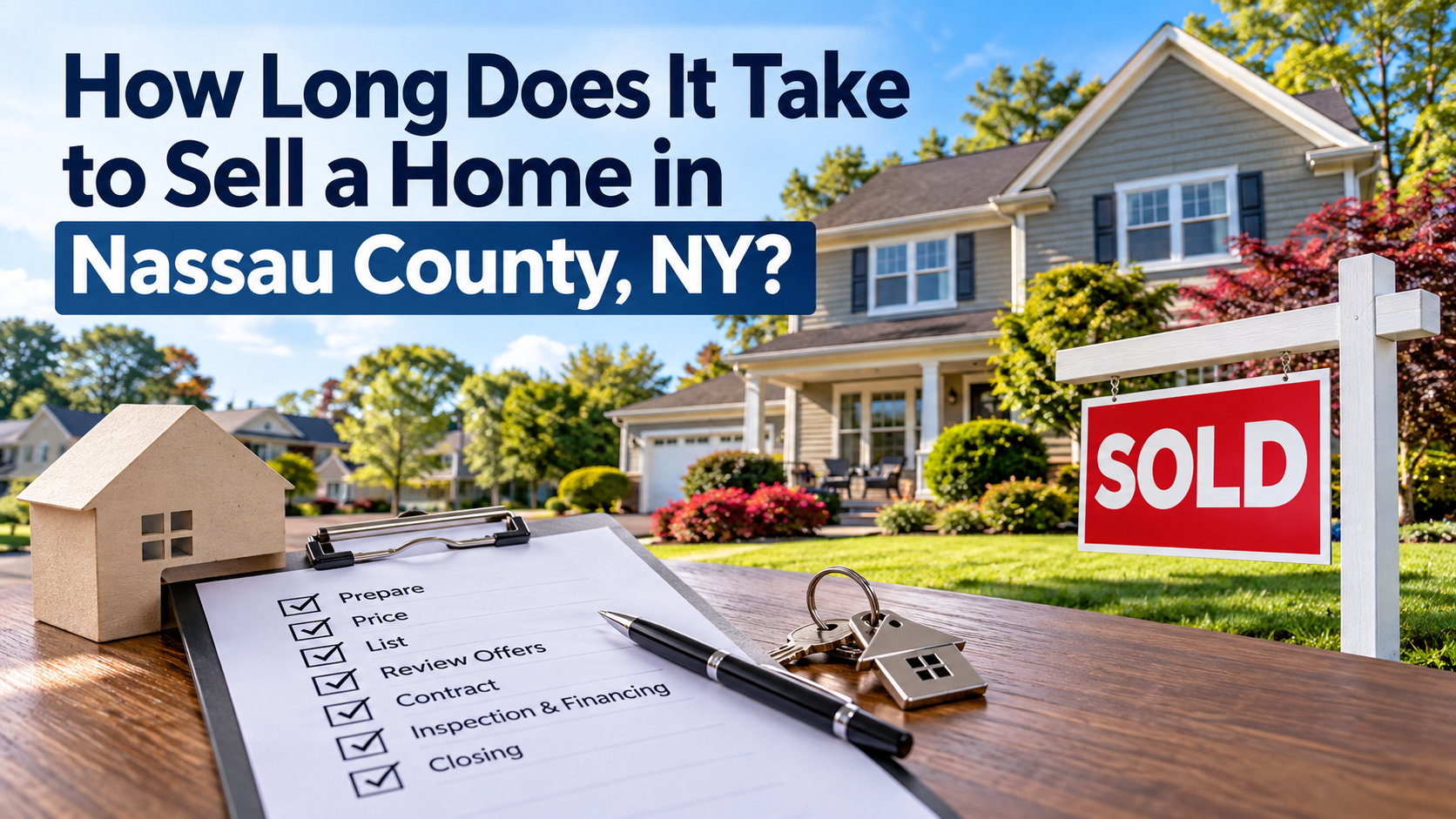
Based on OneKey MLS data from 2024 and 2025, the typical listing-to-contract timeline for Nassau single-family homes runs about 20 to 35 days depending on season and price tier, and most financed transactions close roughly 45 to 60 days after contract. Plan on a total listing-to-closing timeline of about two to three months under normal conditions, per
New York State Bar Association residential closing practice guidance.
Frequently Asked Questions
Is spring really the best time to sell in Nassau County, or is the market strong year-round now?
Spring still produces the fastest sales and highest sale-to-list ratios in Nassau County, with homes listed March through May going under contract about 12 days faster than homes listed in Q4, according to OneKey MLS data. That said, near-decade-low inventory has kept the market seller-favorable in every season. The advantage of spring is real but narrower than it was before 2022.
If I want to move after the school year, when should I list my Nassau County home to close by summer?
List in March or April. A spring listing typically produces a contract in 20 to 35 days, and financed transactions close roughly 45 to 60 days after that, putting your closing in May through July. That timing lines up with Nassau County school calendars, which end in late June, and is exactly what family buyers are targeting.
Do homes listed in winter in Nassau County sell for less than homes listed in spring?
Not dramatically, but the data shows a gap. Nassau County's average sale-to-list price ratio has been highest for homes listed between March and June, with winter listings still performing above 97% but slightly lower, according to OneKey MLS 2023–2024 data. Winter sellers also face less competition from other listings, which can partially offset the smaller buyer pool.
How long does it usually take to sell a house in Nassau County from listing to closing?
Plan on roughly two to three months total. The median days from listing to contract for Nassau single-family homes has ranged from about 20 to 35 days depending on season and price tier, and most financed transactions close 45 to 60 days after contract, per OneKey MLS data and New York State Bar Association closing practice guidance. Municipal requirements, open permits, and title issues can add time, so build in a buffer.
With mortgage rates still high, should I wait until next spring to sell, or list my Nassau home now?
Waiting a full year carries real risk. Nassau County's median closed sale price reached $795,000 in June 2026, up 7.4% year-over-year, and inventory remains well below balanced-market levels at about 2.6 months' supply. Rates at approximately 6.7% (per Freddie Mac's June 2026 survey) haven't stopped buyers, and there's no guarantee rates will be meaningfully lower next spring. Your decision should be based on your own timeline and financial situation, not a bet on rate movement.
How competitive is the Nassau County market right now? Are sellers still getting multiple offers?
Yes, on well-priced homes. The Long Island Board of REALTORS® reported in May 2026 that Nassau County active listings remained below 2019 pre-pandemic counts, and median days to contract was under 30 days. Multiple-offer situations are still common for correctly priced properties, particularly in communities near LIRR stations and in higher-demand school districts like Syosset, Jericho, and Plainview.
Spring still has an edge in Nassau County, and the data backs it up. But the more important variable is pricing and preparation, not the calendar month. A well-priced, well-prepared home in Farmingdale or Bellmore or Massapequa sells in any season. Spring just gives you the largest buyer pool to work with.
If you're weighing whether to list now, next spring, or somewhere in between, I'm happy to run a market analysis specific to your home and neighborhood. It's the only way to know what your timing decision actually means in dollars and days.
Schedule a free consultation with Raja Murthy and get a clear picture of what your home is worth and when to list it.
About Raja Murthy
Raja Murthy is a licensed real estate agent with NB Elite Realty serving Nassau County and Long Island, where he has lived in Farmingdale for over three decades. He helps buyers, sellers, and investors with honest guidance, local expertise, and strong negotiation.
NB Elite Realty · (516) 908-8676
Equal Housing Opportunity. Raja Murthy is a licensed Real Estate Agent regulated by the New York Department of State, Division of Licensing Services. This article is general information only and does not constitute legal, tax, or financial advice. Transfer taxes, closing costs, and contract terms vary by transaction. Confirm all figures and obligations with your attorney, tax advisor, lender, or closing officer. Broker fees and commissions are fully negotiable and not set by law.